There is something rather strange about the way we think about the future.
We look at the Moon and see a barren world. We look at Mars and see an inhospitable planet. We look into space and see distance, danger and enormous cost.
And yet perhaps we are looking at all of this from entirely the wrong perspective.
Perhaps the question isn’t whether humanity can afford to go into space.
Perhaps the question is whether humanity can afford not to.
Because the technologies we are developing today are beginning to challenge assumptions that have existed for thousands of years.
Take something as obscure as tetrataenite.
Tetrataenite is not a rare-earth metal, as it is sometimes described. It is an unusual ordered iron-nickel alloy, naturally occurring in meteorites, with potentially valuable magnetic properties. Scientists have been trying to reproduce the material artificially because, if it can be produced economically, it could potentially provide an alternative to some permanent magnets that currently depend on rare-earth elements.
And that raises a fascinating question.
If we can manufacture tetrataenite, could we manufacture it somewhere other than Earth?
Could we make it on the Moon?
The Moon already contains enormous quantities of iron-bearing minerals. Nickel is more difficult, but it exists in lunar material and, particularly interestingly, in meteoritic material deposited by impacts over billions of years.
So imagine a future lunar industrial facility.
It mines lunar material.
It separates iron.
It identifies and concentrates nickel-rich material.
It produces the appropriate iron-nickel alloy.
It applies the necessary processing to create tetrataenite.
And then it manufactures magnets.
But why would we do this on the Moon?
Because perhaps the Moon shouldn’t be thought of as a place where humanity builds another Earth.
Perhaps it should be thought of as a place where humanity builds something Earth does not need to contain.
Heavy industry.
Mining.
Smelting.
Refining.
Manufacturing.
Energy-intensive processes.
The things that have historically required us to dig into our planet, extract its resources and transform them inside the very biosphere that supports us.
And here is where the idea becomes much bigger than tetrataenite.
Imagine a lunar industrial base where humans are barely present.
Not thousands of miners living in lunar settlements.
Not workers descending into dangerous mines.
Not people standing beside furnaces and processing plants.
Machines.
Robots.
Artificial intelligence.
Autonomous vehicles.
Automated processing plants.
A human might not even need to be on the Moon.
The machines could mine the surface, transport material, process it, repair themselves, manufacture replacement components and continue operating.
A human could be sitting on Earth.
Or perhaps in an orbital station.
Watching.
Monitoring.
Intervening only when necessary.
And this changes the economics of dangerous work.
A human cannot simply be told to enter an area where there is a high probability of being killed by a collapsing structure or a meteorite impact.
A robot can.
If the economic value of the material is greater than the cost of losing the machine, the machine can go where humans cannot.
And if that machine is destroyed, another can replace it.
Eventually, perhaps, another machine could manufacture the replacement.
The industrial system begins to maintain itself.
That is when the concept of a lunar mine becomes something very different from a terrestrial mine.
It becomes an autonomous industrial ecosystem.
And artificial intelligence could become the nervous system of that ecosystem.
One machine encounters an obstacle.
It decides how to deal with it.
Another breaks down.
The system dispatches a repair unit.
A processing plant experiences a reduction in nickel production.
The system reallocates mining resources.
A lunar industrial AI could make thousands of decisions without asking a human what to do.
Humans would increasingly move away from doing and towards deciding what should be done.
And that distinction may turn out to be one of the most important changes in human history.
Because this isn’t just about the Moon.
AI is already beginning to demonstrate something extraordinary.
For most of human history, if something needed to be done, a human being had to do it.
If we needed food, humans grew it.
If we needed buildings, humans built them.
If we needed calculations, humans calculated.
If we needed information, humans searched for it.
If we needed machinery, humans operated it.
Technology made humans more productive, but humans remained at the centre of production.
Artificial intelligence is beginning to break that relationship.
We can increasingly tell a machine what outcome we want and allow it to work out much of the process required to achieve it.
We are therefore creating technology specifically designed to reduce the amount of human labour required.
And that creates an extraordinary paradox.
Our society has traditionally been organised around the idea that people need employment in order to obtain the resources necessary to survive.
Work gives us income.
Income gives us access to food, housing, clothing, energy and everything else we need.
So we built an economic system around human labour.
And now we are developing technology whose fundamental purpose is to reduce the requirement for human labour.
In other words, we are beginning to make our own jobs redundant.
And perhaps that isn’t a failure of AI.
Perhaps it is a sign that our social structure is reaching the limits of its usefulness.
We often hear people say that AI must not develop too quickly because it could destroy the fabric of society.
But perhaps we should ask a different question.
What if the problem isn’t that AI is developing too quickly?
What if society is changing too slowly?
Perhaps the challenge isn’t to stop AI.
Perhaps it is to learn how to live with it.
To control it where control is necessary.
To understand it.
To work alongside it.
And, most importantly, to redesign the structures that were created for a world in which human labour was scarce and necessary.
That brings us to economics.
We talk about economics as though it were a law of nature.
But it isn’t.
Money isn’t a law of physics.
Ownership isn’t a law of nature.
The concept of wealth is something humanity created.
We assign value to objects and services.
We exchange those values.
We accumulate them.
We use them to obtain other things.
And our entire society has developed around this system.
But what happens when technology begins to make many things abundant?
What happens when machines can produce food, manufacture goods, construct buildings and extract resources with very little human intervention?
What happens when the Moon and eventually asteroids provide access to enormous quantities of raw materials?
What happens when energy becomes increasingly abundant?
At some point, perhaps the question isn’t:
“How much does this cost?”
Perhaps the question should become:
“Do we need it?”
“What resources does it require?”
“What happens if we do it?”
“What happens if we don’t?”
“Could we do it somewhere else?”
“Could we achieve the same result with less damage?”
That is a fundamentally different way of organising civilisation.
It doesn’t necessarily mean that economics disappears overnight.
Scarcity would still exist.
Resources would still need to be allocated.
Decisions would still have to be made.
But perhaps money doesn’t need to be the mechanism through which every decision is made.
Perhaps we could begin to think in terms of resources, consequences, necessity and long-term benefit.
Because there is another contradiction at the heart of our present system.
We say we need economic growth.
We say people need jobs.
We say companies need profits.
We say consumers need to consume.
And at the same time we say we have to stop consuming resources, reduce emissions and prevent climate change.
We are therefore trying to solve an environmental crisis while maintaining a system that rewards increasing consumption.
Perhaps there is another way.
Perhaps instead of simply telling humanity:
“Consume less.”
we should eventually be able to say:
“Produce differently.”
And this is where space industry could become extraordinarily important.
The objective would not necessarily be to move humanity away from Earth.
It would be to move the industrial burden away from Earth.
Earth is an extraordinary place.
It has an atmosphere.
Liquid water.
Oceans.
Forests.
Agriculture.
Animals.
Plants.
A biosphere.
It is the one place we know of where human beings can live naturally.
And yet we have built our industrial civilisation directly inside that biosphere.
We mine the planet.
We burn its resources.
We process materials.
We manufacture products.
We transport them.
We consume them.
And we dispose of them.
All inside the same closed biological system that sustains us.
What if we eventually separated those functions?
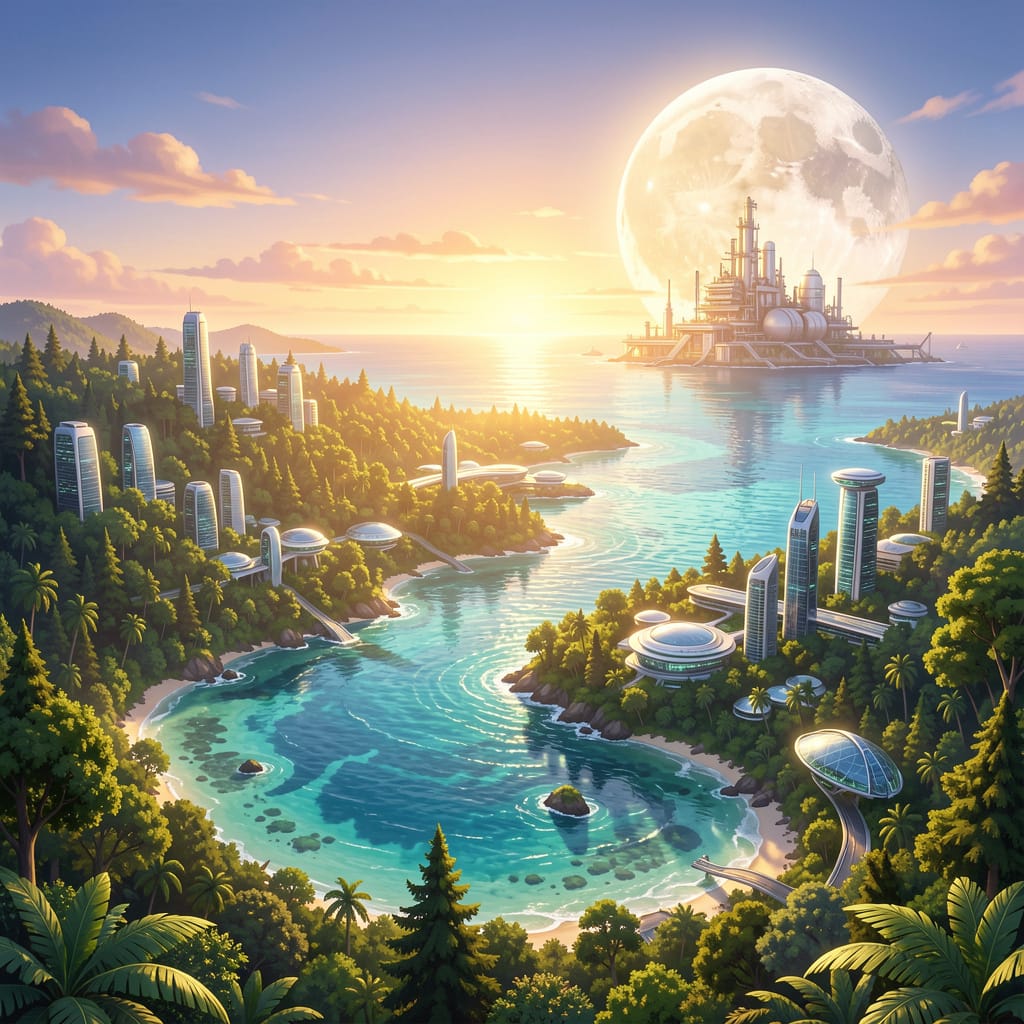
What if Earth increasingly became the biological home of humanity while the Moon became part of the industrial infrastructure of humanity?
Mining could take place there.
Metallurgy.
Smelting.
Manufacturing.
Construction.
Energy production.
Perhaps eventually even chemical processing.
And asteroid resources could provide materials that are scarce on the Moon.
The result could be something like an Earth-Moon industrial economy.
Earth for life.
The Moon for industry.
Asteroids for raw materials.
Space for manufacturing and energy infrastructure.
It sounds radical.
And it is.
But perhaps radical circumstances require radical thinking.
Because there is another thing we need to consider.
Environmental damage on Earth isn’t necessarily caused simply because humanity does things.
It is caused by where and how we do them.
If we could perform an industrial process somewhere where it doesn’t damage Earth’s atmosphere or biosphere, then we could potentially reduce the environmental burden on Earth without necessarily reducing human capability.
That doesn’t mean the Moon has no environment.
It does.
Lunar dust, geological sites and scientifically valuable locations could all be damaged by industrial activity.
But the Moon does not have Earth’s biosphere.
Its environmental consequences are fundamentally different.
And perhaps that makes it an appropriate place for some forms of industrial activity.
Initially, of course, this would be enormously expensive.
Everything would have to be sent from Earth.
Rockets.
Machines.
Solar panels.
Processing equipment.
Communications systems.
But the objective wouldn’t necessarily be to keep doing that forever.
The objective would be to establish an industrial base capable of making more of its own equipment.
Earth provides the initial machinery.
The Moon provides the raw materials.
The machines manufacture replacement machines.
The industrial base grows.
And eventually, perhaps, the Moon no longer depends entirely upon Earth for its industrial existence.
That is when the economics begin to change.
Because the Moon’s gravity is only about one-sixth that of Earth.
Launching material from the Moon is considerably easier than launching it from Earth.
Eventually, lunar products could potentially be transported into orbit and then to Earth.
Not raw lunar dirt.
High-value products.
Magnets.
Specialist materials.
Components.
Energy systems.
Perhaps technologies we haven’t even imagined yet.
And perhaps the first customers for lunar industry wouldn’t even be people on Earth.
They would be the machines on the Moon.
Lunar industry could build the equipment needed to expand lunar industry.
And that creates a feedback loop.
Resources produce machinery.
Machinery extracts more resources.
Those resources produce more machinery.
The industrial system expands.
And the more autonomous it becomes, the fewer humans are required.
This is where AI, robotics, space industry and the future of economics all converge.
Because if machines eventually perform most of the necessary labour, we have to reconsider what human beings are actually for.
If someone doesn’t need a job to obtain food, what does work mean?
If a machine can build a house, what does human labour mean?
If AI can analyse information faster than a human, what does expertise mean?
If robots can manufacture the things we need, what does production mean?
Perhaps the answer is not that humans become irrelevant.
Perhaps humans move towards something different.
Thinking.
Questioning.
Creating.
Exploring.
Deciding.
Determining purpose.
The machine may be able to answer:
“How can we do this?”
But perhaps the human question becomes:
“Should we?”
That distinction may become increasingly important.
And this brings us back to the fundamental problem.
Perhaps the biggest limitation on humanity’s future isn’t technology.
Perhaps it is the framework through which we decide what technology is allowed to accomplish.
We have created a civilisation around scarcity.
We have created systems around ownership.
We have created systems around accumulation.
We have created systems where survival is often tied to employment.
And now we are developing technologies that could progressively undermine each of those assumptions.
AI can reduce the requirement for human labour.
Robotics can reduce the requirement for human physical work.
Automation can operate continuously.
Space can provide new resources.
The Moon can potentially provide an industrial environment outside Earth’s biosphere.
Asteroids could eventually provide resources on a scale far beyond anything available on Earth.
So perhaps the question humanity faces isn’t:
“How do we stop this?”
Perhaps it is:
“How do we adapt?”
Because stopping technological progress may simply preserve an economic system designed for a world that no longer exists.
Perhaps we need to redefine economics.
Perhaps we need to redefine distribution.
Perhaps we need to redefine work.
Perhaps we need to redefine ownership.
And perhaps, ultimately, we need to redefine purpose.
Imagine a civilisation where a person’s right to food doesn’t depend upon whether they have a job.
Where housing isn’t necessarily determined by wealth.
Where education is available because knowledge benefits everyone.
Where machines perform the dangerous and repetitive work.
Where AI manages complexity but humans determine objectives.
Where resources belong to humanity rather than simply to whoever can afford to own them.
Where industrial growth doesn’t necessarily mean destroying more of Earth’s biosphere.
Where humanity can expand into space without abandoning the planet that gave us life.
That doesn’t mean human greed disappears.
It doesn’t mean competition disappears.
It doesn’t mean scarcity disappears.
And it certainly doesn’t mean that the transition would be easy.
Human beings have spent thousands of years building the systems we have today.
Those systems have created enormous prosperity, but they have also created inequality, conflict, environmental damage and a culture of possession and consumption.
Changing that would require something much more difficult than inventing a new machine.
It would require changing the way we think.
But perhaps technology is already forcing us to do exactly that.
AI is making us question the necessity of human labour.
Robotics is making us question the necessity of human physical work.
Space technology is making us question the limits of Earth’s resources.
And the climate crisis is making us question whether our current industrial model can continue indefinitely.
Perhaps these aren’t four separate problems.
Perhaps they’re four parts of the same transition.
Humanity is developing the technological capability to move beyond a civilisation based entirely upon human labour and terrestrial resources.
The question is whether our social structures can evolve quickly enough to accommodate that capability.
And perhaps, ultimately, the future isn’t about making humans work harder.
Perhaps it is about making humans think better.
To ask better questions.
To understand consequences.
To decide what is actually necessary.
To use machines to do what machines are better at doing.
And to preserve human beings for the things that make us human.
Because perhaps the ultimate purpose of artificial intelligence, robotics and space industrialisation isn’t to create a richer civilisation.
Perhaps it is to create a civilisation that no longer needs to destroy its own home in order to sustain itself.
And perhaps the Moon isn’t the destination.
Perhaps it is the beginning.
The beginning of a civilisation where Earth becomes the home of humanity…
while the rest of the Solar System gradually becomes the workshop that sustains it.
(Before you waste your time checking if this comes out as having been produced by AI, I can tell you it will. Of course it will. What it won’t tell you is how we came up with this monologue transcript and the countless hours debating, questioning and eventually coming up with something others could understand condensing hours into minutes. A project which highlights how human creative thinking, out of the box concepts and however you wish to describe AI, can ultimately work together to reach the objectives of the human creator)


Leave a Reply