There was a time back in the late 1980s and early 1990s when such a thing as a digital camera was somewhat a figment of people’s imagination.

Then came the personal computer with its digital imaging software, the digital cameras and, of course, the debate. Oh God, do I remember the debate… all photography would be lost, people wouldn’t know how to take photos, nothing could replace darkroom work, blah blah. It never actually happened as they said. Fear — fear did happen. But society embraced the new era and photography continued with its new ways of doing things. Actually, more people probably take photos and practise photography now than ever before. It’s a simple case of mathematics and economics. Whereas we could only take 24 or 36 shots before and, if we were lucky and had the money to use a darkroom — something I never had other than in college — we would be able to produce our own prints and work on them.

Nowadays, the software does most of this work for us. For some, it still seems to raise the debate, but that’s when you actually realise that the people who continue the same debate often do not know how to use the tools. Personally, I still burn into my images, or dodge, I still tweak brightness and contrast as if I were using a darkroom, and I still work on colour and saturation with the tools that keep closest to the darkroom process.

And yes, if I wish to create a composite, I still mask in and out as I used to do in a darkroom, but with far greater refinement because of the tools available.

But let’s regress. The idea of this blog is not about the debate, but the capture.

Back in the late 1980s, I remember picking up my Praktica and heading into the streets to take some street shots. This was after a week messing about using a cardboard box with a pinhole and exposing some photographic paper to capture something, then heading to a darkroom to complete the process and get a print.

That day I went out to take street shots with my Praktica is not a day I forget easily. It was the moment things blended together in such a way that my interest in street photography emerged.
It was a moment of realisation. Capturing an arrest, and the shots that followed as a group of people tried to remove the camera from me. In the darkroom, as the images emerged, there was a clarity about what had happened and what I had done. Seeing those moments captured, and being asked by my tutor whether I was going to sell them to a newspaper or magazine, was like a lightbulb moment.
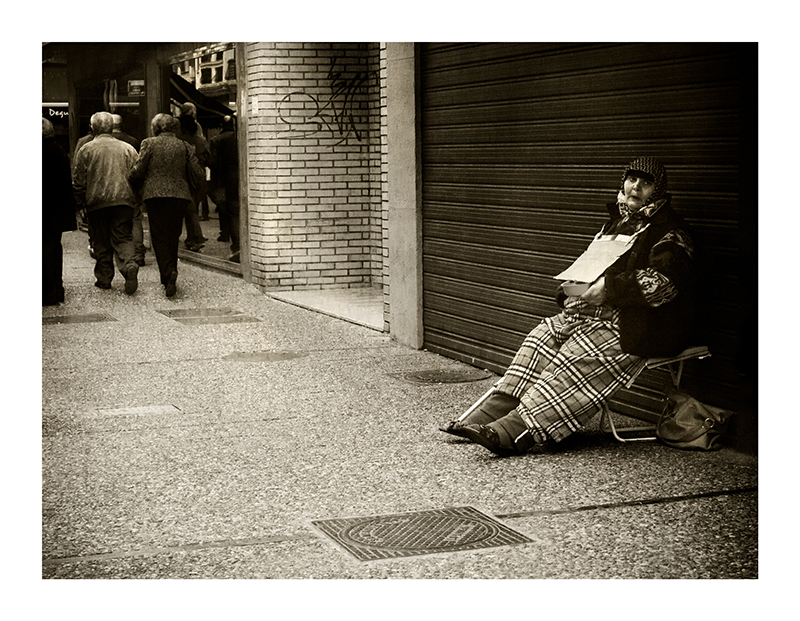
This was documentary photography.

It wasn’t about being technically perfect. It wasn’t about getting the beautiful, perfectly aligned image. It wasn’t about people smiling, grouped together or perfectly displayed within a frame.
It was about capturing a moment which later told a story. Not just through the image, but through its imperfections, its misalignments, its blur and focus.
As the digital world started to grow, my photography in many ways initially fell away.
It was not until I got myself a compact camera and, a few years later, a DSLR that I returned to this type of photography.
And I started capturing moments again.

They were, in many ways, a replacement for something I wasn’t doing. I wasn’t drawing or painting at the time. I was capturing moments and it felt like the right thing to do.
Until suddenly I stopped. Ironically, because I rejoined the media and the way I had joined it was not with photography as its focus.
However, the view of photography as a tool to capture moments had never disappeared.
What did disappear was my perspective on things. No longer could I see the picture, no longer could I see what was happening in the same way I had seen it for many years. And this was not because the camera wasn’t any good, nor because I didn’t know how to take a photo. It was merely because I could no longer see those moments; there was distraction in my mind.
All in all, the lesson was simple. Throughout the decades, what I learnt about photography — which very much brushes away that debate from the early 1990s — was that capturing the moment does not rely on what type of camera you use. Whether it’s digital or analogue, it doesn’t matter whether it’s a pinhole in a shoebox or a DSLR camera. The real tool, the real capture, comes from your perspective and what you see.
From the smile to the tears, the glance to the shrug, the touch to the tumble.

Understanding and seeing the world around you. Seeing, listening and feeling the story before you. That is the true capture. The image is just a record, providing your interpretation of the moment at that point in time for others to see.
You could be capturing images without a camera and still be involved in documentary photography. It’s just that nobody will see those images unless you can communicate them in another way. Now that is what I call art.


Leave a Reply