That’s a heavy title, isn’t it?
You’re probably expecting a long lecture about climate change, saving the planet, and all the usual talking points. I’m not going to do that—at least not in the way you might expect.
Instead, I’ll start with one simple statement of fact:
I am just one person. I cannot change the world. I can only change my life.
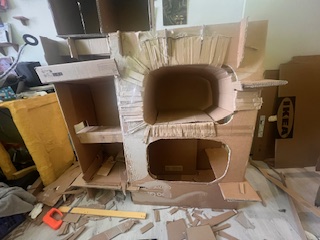
And this is how that idea became real for me.
Just under three years ago, I found myself basically homeless. Everything I had built over twelve years of family life was gone. All I had were a few bags and what I could carry.
I had a job—but not the kind of wages that let you rent privately and survive, especially with a daughter and rising living costs.
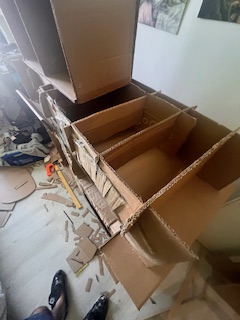
Eighteen months ago, after relying on vouchers and handouts just to get by, I was offered a government flat. There was a catch: it needed repairing before I could even live in it.
I took the risk.
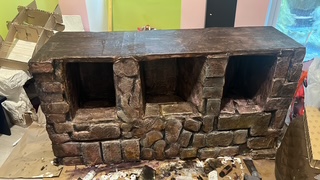
With no real budget and no contractor willing to work within it, I had no choice but to do everything myself. Somehow, I managed to fix what was essential.
But fixing the flat was the easy part.
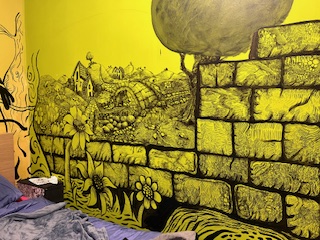
Starting again from nothing—that’s where reality hits.
When you need everything—bed, cooker, water heater, plates, cutlery, even saucepans—you quickly realise how expensive “starting over” really is.
Most people have some kind of support: family, a partner, savings, or even just help getting started. I didn’t. Just a few friends, a son who had already done more than enough to help me survive, and a job that seemed to stretch less and less each month.
So the question became simple:
How do you build a home when you can’t afford to buy one?
The answer was creativity.
At first, it wasn’t a philosophy—it was survival.
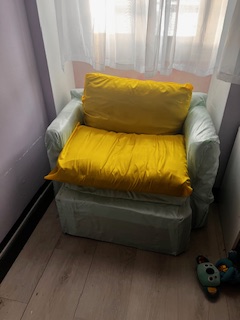
It started with a sofabed my former landlady was going to throw away. She offered it to me, and that small gesture changed everything.
It wasn’t usable as a bed. It didn’t really work as a sofa either.
So I broke it apart.
Partly because I had no transport and needed to carry it piece by piece—but also because something clicked.
Every part of it had value.
The wood. The frame. The foam. The boards.
From that one sofabed came two armchairs, shelving, and cupboard materials.
That was the moment everything changed.
From then on, I stopped seeing things as “waste.”
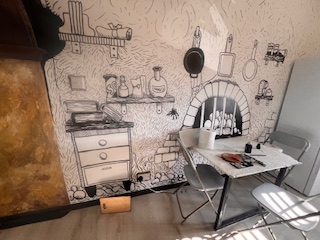
I needed skirting boards, but couldn’t justify the cost. So I used leftover flooring. Cut-offs became shelves. Spare pieces became surfaces. With a bit of paint and some imagination, things started to take shape.
And it didn’t stop there.
Cardboard boxes. Plastic bottles. Shopping bags. Packaging. Even handles from reusable bags.
Everything had potential.
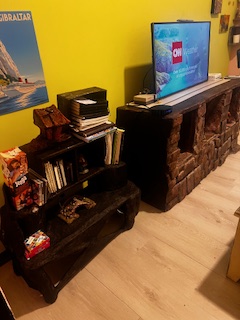
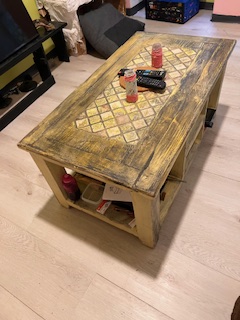
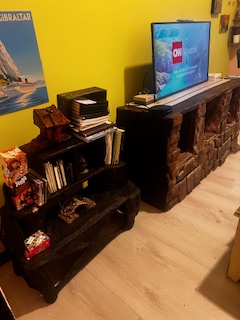
Slowly, the flat filled up—not with purchased furniture, but with things I had made.
Wardrobes. Storage units. Shelves. Tables. Even decorative features.
Some of it looks rough. Some of it is uneven. There aren’t many straight lines.
But that was never the point.
This isn’t a showroom—it’s a home.
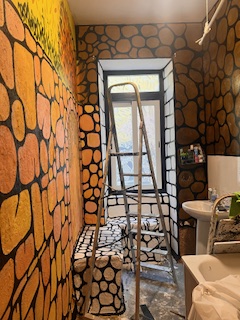
And when you stop trying to make everything perfect, you start making things possible.
Over time, the process evolved.
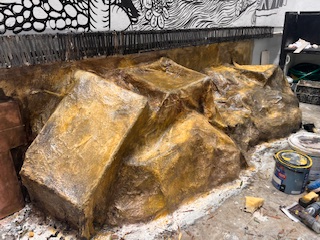
Papier-mâché mixed with cement. Wood combined with plastics. PVA glue, paint, trial and error.
For the past year, my flat has basically been a workshop—something my son regularly reminds me of.
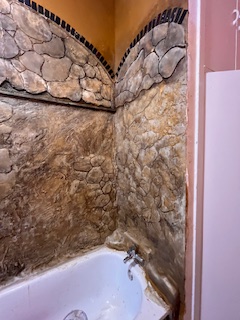
But alongside that, something else changed too: how I see things.
When you strip away labels, everything becomes material.
A plastic sheet becomes waterproofing.
A bent piece of metal becomes a hook.
Cardboard becomes structure.
Old cables become clotheslines.
Paint tins become part of something bigger.
It’s not about what something is. It’s about what it can be.
So where does sustainability come into all this?
It’s simple.
Every time you reuse something, that’s one less item going to landfill.
Every time you build instead of buy, that’s one less product being manufactured, packaged, and transported.
Some of what I’ve made won’t last forever. Some of it might last years.
But in that time, I’ve reduced waste—and avoided creating more.
What started as necessity has now become habit.
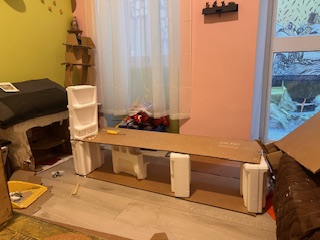
Even now, when I can afford something, I hesitate. Not because I don’t want it—but because I want to see if I can make it first.
Am I doing this to save the planet?
Not really.
That might be a result—but it wasn’t the reason.
This started because I had no choice.
But maybe that’s the point.
Change doesn’t always come from intention. Sometimes it comes from circumstance.
So why doesn’t everyone do this?
Maybe they could. Maybe they won’t.
That choice isn’t mine.
Because at the end of the day, I can’t change how other people live.
I can only change how I do.
 stephenignacioart
Leave a comment